I have talked about Universal Basic Income on this blog a few times over the years and my opinion hasn’t changed: UBI is needed as part of a transitionary tool from late-stage capitalism to a heavily automated, potentially post-capitalism, society. But it has been a few years, so I wanted to circle back around to it and refresh the point I was trying to make with the context of a few more years lived and the societal and technological changes we’ve seen.
My Previous Articles
- Basic Income – Not Just About Giving Money – April 2017
- My Idea: Ontario Provincial Election Edition – May 2018
- UBI: A Transitional Economic Tool – August 2019
- NIT vs Basic Income: My “Basic” Thoughts – December 2019
My main caveat when talking about UBI is that it isn’t a singular solution.
Universal Basic Income has to be a small part of a major overhaul of our tax system. We can’t just give everyone money without vastly changing how we collect money and where we collect money to pay for it all.
Smarter people than I have done great work on figuring out what the cost to value implications of UBI could be. I am going to talk in hypotheticals and hopes rather than facts and figures and just point out some things I’m seeing that concern me.
Artificial Intelligence and automation are here and it is an exponential curve
I don’t want to get into a fight about what is and isn’t AI because that’s not really the point. The fact is that these systems have and will continue to take jobs from people and in our capitalist system, not having a job means not having any reasonable quality of life.
Wait but Why has a great image talking about how bad we are at projecting future progress.
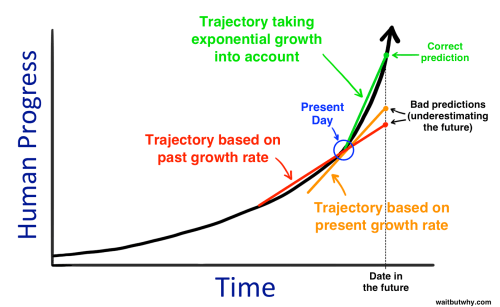
We, as humans, are bad at looking forward and predicting the future, especially when faced with something on an exponential curve because we are programmed to look at previous patterns and extrapolate the future from that.
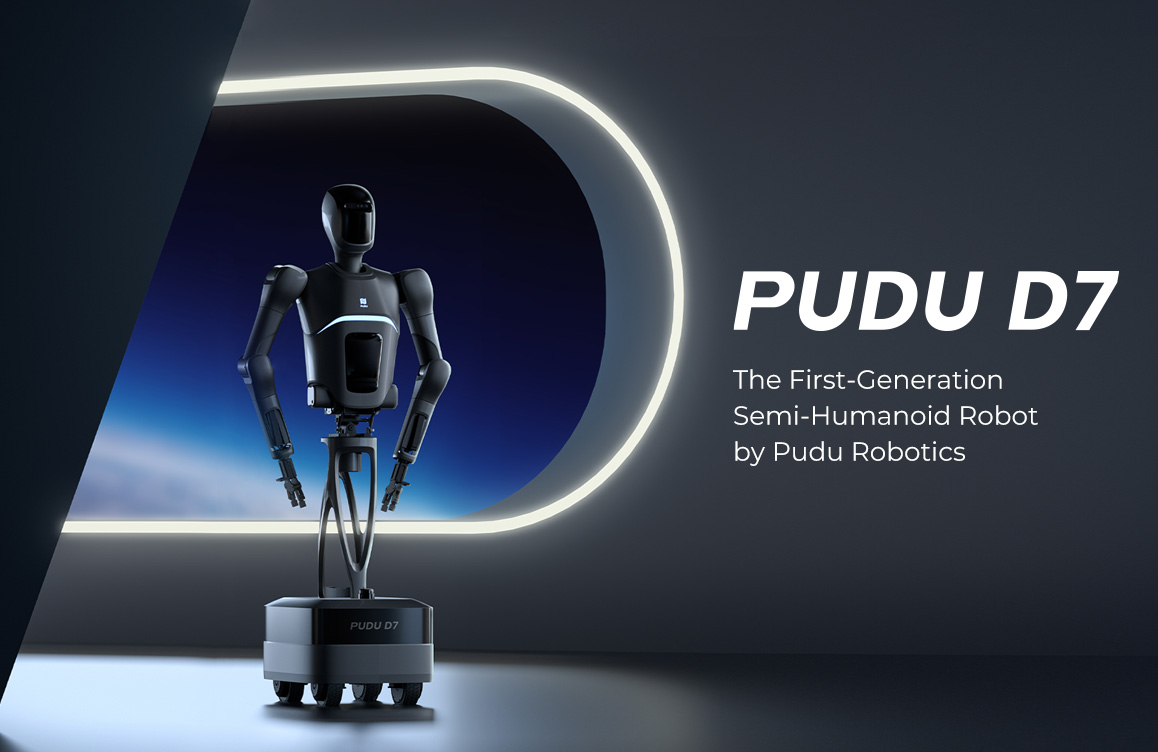
If you went back to Malcolm in 2019, the last time I wrote about UBI and told him that in less than five years, he’d have access to an AI that in many ways makes SIRI from the time look like a toy, or that he’d be consulting with AI to program scripts, or that there would be thousands of humanoid robots being built in factories around the world, he’d probably both laugh and face palm.

If each of these companies release around 10,000 units per year, which is what Agility expects to do with their Digit robot, then we would have around 100,000 humanoid robots per year, and that doesn’t even include semi-humanoid robots or non-humanoid robots.
If they are able to grow their manufacture rate by only 10% per year industry wide, that would mean being able to replace every employed person currently in Canada with an individual robot in less than 32 years!
(There are currently around 20 million people working in Canada and at 32 years we’d be at 20,113,777 humanoid robots)
It also feels like every single “AI” system over the last two years has improved by leaps and bounds with no signs of slowing down yet. I am hopeful that this AI explosion will be an S curve technology and we will see a slow down where we can all catch our breath, but for an example, here is what Midjourney did in a year and a half.
They went from this:

To this:

We’ve watched as various companies have released their large language models, and OpenAI recently released their o1 preview model which they claim to be a reasoning large language model. We are seeing AI tools to create pretty much any content and these models are being hooked into machines.
Here is a demo from six months ago with the Figure 01 humanoid robot running OpenAI’s Speech-to-speech reasoning.
And here is their Figure 02 introduction from five months later showing its physical capabilities, specifically showing the types of jobs it could do.
Why Does AI and Automation Matter in the Context of UBI?
Take time to think about your own job! How much of it could be automated? What about if there was a humanoid robot? What if there was a non-humanoid robot? What if there were AIs that could code, write copy, create images, create audio, create video, understand context, and more?
In my current job, there are a few main parts:
- Stay knowledgeable about our products and services from a technical perspective
- Identify, support, and research solutions to complex technical problems involving one or more of our products
- Communicate and consult on the potential paths forward for clients to take
- Voice client concerns, goals, and desires to the company for future product enhancements
When I break down my job into smaller and smaller tasks, I can foresee a near future where different types of limited AI tools could work together to provide a faster, better, and deeper set of solutions for my clients.
I’m already using AI to help me sift through complex logs, develop useful search queries and scripts, and enhance my abilities to provide a better experience. I’m sure I’ll continue to expand my use of different work approved AI tools to assist me in providing positive outcomes to my clients.
And maybe on my client side, they’ll use AI tools to implement the adjustments and ideas that I come up with to develop code, to check their code for bugs, to write the various tests for QA tools, and to confirm the production implementation is working as expected.
How long until they cut out the middle people and go right from businesses having proprietary product AIs talking to developer AIs?
So what will I do then?
Learn more: If you are interested in AI, check out Perplexity’s podcast completely created by AI called Perplexity Discover Daily.
UBI Isn’t a Solution, it is a Stopgap
When people talk about Universal Basic Income, they make it seem like it would solve so many problems, and potentially power up the economy because putting dollars in the hands of regular people can be doubled through business growth and other complex systems that I don’t entirely understand, but just handing money to everyone in a country won’t be a long term solution. It can’t be. At some point, if we have many more people taking from a system than paying into it, then it can’t work, right? Debt can’t grow forever.
So at what percentage of unemployment in Canada does our system fall down? We are currently at a bit over 6% and maybe heading to 7%, but the youth unemployment rate is up to 13.5%. What if that is the start of a wave of unemployment that follows them as they age? What if 13.5% is the new normal? What if it doubles? Triples? At what point is it a fundamental problem that requires the government to really step in and find other ways to fill their coffers so they can help more people?
We already see food banks running out of food faster than they ever have.
Learn more: Record-breaking number of Ontarians used food banks last fiscal year
All of our social assistance programs and mental health programs are failing to meet the growing demand, a demand that is outstripping the growth in our population alone.
There are many people that believe giving people “hand-outs” is wrong. That they should work as they did to earn a living. But what if there is no one hiring in any of the fields you have abilities in? Then they should start a business, right?
What if starting a business makes no sense because there are no customers? What if the majority of people have no disposable income to buy what you are selling? How will you compete when companies with deep pockets or some technical advantage can automate what you currently need people with salaries to accomplish?

Digit, the humanoid robot being used in Amazon warehouses, will eventually cost three dollars ($3) per hour to operate and maintain. Could you afford your life making less than that? Why should a company pay you more than they can pay a robot?
You might think that all this will never happen, but we are already seeing it in the content creation space. There are writers who have been let go because multiple “AI” tools strung together with different commands can mix and match different insights together faster and cheaper than any human writer ever could and businesses are seeing that they can spend less than $100 to get similar results to what would have needed $1000’s in budget previously.
This will happen with easy to automate jobs first, and then seemingly harder ones over time. But it will happen. CGP Grey put out a great video ten years ago now called Humans Need Not Apply and check out Is AI Still Doom where CGP Grey and Myke Hurley talk about it ten years later.
So, let’s take that thought experiment to its conclusion: no one works because robots and AI do everything. Sounds great, right? Well, under capitalism, if you don’t work, you can’t purchase goods and services.
So maybe now you live under boxes that you stole, in a field with a bunch of other people living under boxes that they stole. I know… sounds grim and it is not what we expect for our future.
Automation and the Utopian Future
I think we all expected that when these technologies started to mature that we would see a reduction in work hours, more free time, lower cost goods and services, and maybe a transition to a post-capitalist society like in Star Trek, where people only work because they feel compelled to. Every once and a while, there are discussions about four day work weeks, or UBI, but in most places they never really go very far. One company here, a trial program there. It isn’t nothing, but compared to the pace of change in automation, robotics, and artificial intelligence, it is nearly nothing.
If we want a low/no-work future that is comfortable for humanity, then I don’t think enough people are asking: how do we get from here to there in an appropriate amount of time?
So many of us are busy defending what little we have. Protecting ourselves, our families, our communities, our countries from the “enemy” that most people have missed what is happening to capitalism.
The goal of capitalism was always to funnel all of the money to one person, eventually. Government was meant to limit capitalism to slow this eventual end goal.
You’ve probably all seen some version of the following:
That’s a simplistic version of how capitalism works. Competition drives the price down and then the person with the most capital buys the smaller competitors allowing the monopoly to set the market terms.
You might be saying “but they need customers!”
You are right, they do, but to what extent? If you were a billionaire tomorrow, would you work? What would you buy with that money? Freedom through products and services? Maybe a robot vacuum to clean your floors? Maybe that Figure 02 looks like it would be great at loading and unloading your dishwasher? How much human capital would you need to keep a high quality of life? What purchases would matter to you during the fall of capitalism? Land? Food production? Technology? Power? Security?
It is said that the game of Monopoly was designed to highlight the dangers of capitalism, but I feel like that message has been lost on most people as we can’t help but be self serving to avoid discomfort. No one wants to lose and so we fight to try to make the most of what we can get our hands on hoping that it will be enough to have some level of comfort and safety, but it is a laughable distraction when you compare it to someone with multiple millions of dollars.
The cost of goods and services is not fixed, but you as an individual consumer don’t control it.
There are economic pressures called inflation and deflation that are manipulated in so many ways. I’ll admit that I don’t understand them, but we’ve been hearing more about them since Covid happened, especially since they seem to be negatively impacting the average person.
If UBI were to happen, the system seemingly flooded with money to help those that are unable to find a job, what will happen to the prices of goods and services?
The expectation is that they’ll go up because there will potentially be more competition for them. Then UBI will no longer cover the goods and services it is meant to cover, and we will be back where we started: people unable to have a roof over their head, clothes on their back, and food in their belly.
Could automation and AI reduce costs allowing UBI to be more useful? Potentially, but will capitalists allow it?
Supply and demand is something that is often brought up in these discussions, but it is a false metric. Demand is often created and supply is often controlled.
We only have so many materials, so much electricity, so much land, so many hours to produce, and so much time to distribute whatever is created.
In a world that currently exists in a constant glut of limitations and capitalist requirements, it is unlikely that the average cost of goods and services will see a true drop over time, or if they do drop, then there will likely be additional societal pressures to have other products or services that increase our overall cost of living.

Should People on UBI Have Cars? Cell Phones?
When I talk about societal pressures to have other products or services that increase someone’s overall costs, I am talking about building cities that require cars. I am talking about job applications only being accepted through email. I am talking about the home phone line no longer being a typical service for a household and now each person needing their own cell phone. I don’t even know if you can get a home phone line anymore…
These are costs that previous generations might not have needed to account for that current and future generations do. As remote work grows, the tracking of work effort blurs and some people are on the advantage side where they work less than their expected hours each week and others are on the disadvantage side where they work more hours each week.
But taking this back to UBI, you’ll quickly see how people feel about the idea when you ask them what someone depending on UBI should have. Who decides what quality of life is good enough for those subsisting on basic income? What amount of money, goods, or services is “fair”?
Capitalism causes us to look at others with envy, and comparison is the thief of joy.
We should all be striving for a post-capitalism society.
A society with excess that is freely given. That’s what I want for future generations. I don’t want anyone to ever have to struggle with affording healthy food, the worry of not being able to pay their bills, disadvantages in education and health, or making decisions between happiness and capitalistic servitude.
Heck, that’s what I want for those alive today and shouldn’t we all want that?
If technology is going to take jobs away, why isn’t government making large moves to defend us, the people, that will be negatively impacted by a growing unemployment rate? If automation is only going to get better, why aren’t we seeing reductions in hours worked and lower costs for goods and services?
I don’t think it makes sense to have universal basic income forever, but while the governments of the world deal with corporations and figure out some new or different system, we need something to prevent more and more of us from falling through the cracks and experiencing a life of fear, depression, anguish, and sadness.
Please look into UBI, think about all of the changes that need to happen. Think about the world you want to live in. Advocate for positive change!
Additional Reading / Places to Go Next
And yes, some images for this post were created using Midjourney!
 Malcolm Peralty